 Kyberswap
 Aggregated Trading and Yield Tools
· last updated
Kyberswap combines swap routing, price-based orders and liquidity management in a decentralized finance platform connected to your wallet. The Aggregator searches liquidity sources for token trades, while Limit Order supports trades at a specified rate or better. Cross-chain Swap compares routes between supported networks. On the earning side, KyberEarn brings together third-party liquidity pools and Partner Vaults, with KyberZap handling token conversion for supported deposits. These tools serve different purposes: a swap changes your assets, a pool position supplies trading liquidity and a vault follows its underlying strategy. Their costs, earning conditions and exit choices differ accordingly.
The Aggregator, KyberEarn and KyberZap
The Aggregator routes trades across decentralized exchanges (DEXs), KyberEarn organizes earning opportunities and KyberZap prepares assets for liquidity operations. Their functions overlap when a deposit requires token swaps. KyberZap uses Aggregator routing to convert the supplied assets into the proportions that the selected pool requires. KyberEarn provides the surrounding pool information and position-management interface.
Third-party protocols operate the pools that KyberEarn helps users access. Supported integrations include pools from Uniswap, PancakeSwap and Aerodrome. The chosen protocol and pool determine the liquidity structure and available rewards. Using a shared dashboard does not make every pool the same product or extend every management feature to every position.
Aggregated Routes and Execution Quality
An Aggregator route can divide a trade among liquidity sources when their combined output offers a better result. Pool depth and trade size influence that calculation. A route for a smaller trade can differ from the route available for a larger amount, even for the same token pair.
Price impact describes the effect that a trade has on available liquidity and the resulting execution price. Slippage describes the difference between the expected and executed price. Routing across sources can reduce exposure to a single shallow pool, while the selected slippage tolerance limits the price movement that the transaction accepts. Raising that tolerance permits a wider execution range; it does not improve liquidity.
Limit orders also contribute liquidity to the Aggregator. An Aggregator swap can therefore interact with an active order when that order provides a suitable route.
When Does a Limit Order Fill?
A limit order fills when a taker executes it at the specified rate or better while its conditions remain valid. Setting a price specifies a trade condition; it does not establish that a matching trade exists. Market price, liquidity and order size affect whether a taker can execute it.
The maker sets the trade terms and expiry, and a taker settles an executable trade on-chain. Assets remain under the maker's control while the order awaits execution. An order can expire without a fill, so waiting for a preferred rate introduces a different constraint from requesting an immediate swap. A price shown on a chart alone does not establish that the full order can execute at that price.
Cross-Chain Routes and Destination Tokens
Cross-chain trading combines asset conversion with movement between networks, using supported third-party providers. Kyberswap compares available routes and presents estimated output, fees and arrival times. The output token belongs to the selected destination network, making the destination asset and receiving address part of the trade specification.
Cross-chain coverage includes supported EVM networks and networks such as Bitcoin, Solana and NEAR. Earn and Limit Order have separate compatibility requirements. A network appearing in cross-chain routing does not establish that every other tool operates there. Provider availability also affects which source-and-destination combinations produce a usable quote.
Transaction submission precedes destination delivery. The history panel distinguishes processing from success, with success indicating delivery of the output tokens to the receiving address. Estimated processing time varies with the selected chain and provider. It should not be treated as a fixed completion promise across routes.
KyberEarn Pool Selection
KyberEarn displays pool data that helps distinguish trading activity from incentive-supported earnings. Annual percentage rate, or APR, expresses an annualized rate rather than a fixed payment commitment. Total value locked, or TVL, describes the value deposited in a pool. Neither metric alone explains how much a particular position will earn.
Trading Activity and Available Liquidity
Trading fees come from swaps that use the pool. Comparing volume with TVL helps explain whether the pool attracts activity relative to its deposited capital. Fee history and liquidity utilization add context. A large deposit base with little trading can generate modest fee income, while thin liquidity introduces different execution and volatility concerns.
Rewards and Their Conditions
Liquidity mining and partner bonuses depend on an active incentive program. In eligible pools, FairFlow's swap hook captures arbitrage value for distribution through Equilibrium Gain Sharing. These sources remain distinct from ordinary trading fees. A changing token reward value or an ending incentive campaign can change the displayed APR even when the underlying pool remains available for deposits and swaps.
KyberZap Token Conversion and Pool Entry
KyberZap handles the swaps and ratio balancing needed to prepare supported liquidity deposits. KyberZap supports liquidity entry with a single token or a combination of up to five tokens. The input does not always have to match the pool pair, provided the selected token and pool support that conversion. A concentrated liquidity deposit may also require a price range, which affects the required proportions. The quote exposes estimated output, slippage, Zap impact and applicable fees before confirmation. Those conversion mechanics reduce manual preparation; the resulting position retains the underlying pool's price exposure and smart contract risk.
How Do Price Ranges Affect Pool Earnings?
A concentrated liquidity position earns trading fees while the market price falls within its selected range and trades use that liquidity. Outside the range, the position becomes inactive for trading-fee generation until the price returns or the liquidity is repositioned. The underlying protocol's pool structure determines whether a range selection applies.
A narrower range concentrates capital over fewer prices and raises the chance of becoming inactive after a market move. A wider range spreads capital more broadly, with a different balance between fee efficiency and remaining active. Impermanent loss adds another consideration: the liquidity position can be worth less than holding the deposited tokens separately. Fee income and incentives do not automatically offset that difference.
Pool Positions and Partner Vault Strategies
KyberEarn supports direct pool management and access to partner-managed vault strategies. These paths give the depositor different responsibilities and different exposure to the underlying strategy.
Pool Management and Exit Tools
My Positions brings together position status, accrued fees and rewards across supported pools. Available actions include increasing liquidity, claiming fees, withdrawing, compounding and repositioning. Support varies by protocol and position. Compounding reinvests earnings, while repositioning changes the liquidity range.
Standard withdrawal and Smart Exit return the underlying pool assets in their current ratio. Zap Out converts the withdrawn assets into a selected token. Smart Exit, listed as beta, automates withdrawal for supported positions under signed conditions based on fee yield, pool price or time. Smart Exit also carries a platform fee, displayed before order confirmation. Executors pay execution gas upfront and recover it from exit proceeds, subject to the cap that the user signs. If the required gas exceeds that cap, the order does not execute.
Partner Vault Allocation
Partner Vaults include Liquid ETH, Liquid USD and Liquid BTC on Ethereum. These vaults allocate deposits across DeFi strategies and handle rebalancing and compounding. Supported token conversion allows entry without first holding the vault's base asset. Their returns vary with strategy performance and market conditions. Market-liquidity exits can produce a different amount from native redemption. Native withdrawals usually take about 3 days and can take up to 10 days, depending on the vault's strategies. Smart contract, liquidity and third-party protocol risks remain part of this route.
Costs and Wallet Authorization
Transaction costs follow the selected operation, so a fee statement about one tool does not describe the whole platform. Wallet access is non-custodial, with users controlling their wallets and authorizing transactions. Wallet-submitted on-chain swaps and liquidity deposits need native gas funds on the selected network.
Aggregator Swap Costs
The Aggregator's application programming interface (API) has a zero Kyberswap swap fee. Kyberswap can collect surplus output above the estimate from positive slippage, as well as unconsumed input or intermediate tokens. The confirmed minimum output still applies. Network gas and liquidity-source fees remain separate. An application integrating the API can also configure its own integrator fee, so an embedded swap can have a different cost breakdown.
Cross-Chain Charges
Cross-chain Swap applies a platform fee that varies with the route and token category. A selected third-party provider may charge a separate protocol fee. The route details display applicable charges before confirmation.
Liquidity and Vault Deposits
KyberZap liquidity operations may carry a platform fee based on the input amount and token pair category. This is separate from the position's later earnings. The Liquid Partner Vault deposits described above carry no added Kyberswap platform fee, although token conversion can introduce slippage and price impact. Gas remains a separate transaction cost.
ETH Conversion or an ETH/USDC Liquidity Position
In this hypothetical example, a reader holds ETH on a supported network where an ETH/USDC pool is available through KyberEarn. Their question is whether converting that ETH into USDC would also create a position that earns pool fees.
An Aggregator swap converts the specified ETH into USDC. The received USDC is a token balance, with no liquidity deposit created by that swap alone. Using KyberZap to enter the supported pool has a different purpose: conversion prepares the pool assets, and the completed deposit creates a liquidity position.
The concrete distinction is a USDC balance versus an ETH/USDC pool position. If the selected pool uses concentrated liquidity, the position's fee eligibility also depends on its range. Changing the goal from conversion to earning therefore changes the resulting asset exposure and management task. It does not make the swap route itself a yield strategy.
API Access and Embedded Trading
Developers can access Aggregator routing through an API or add an existing swap interface through the Widget. The recommended Swap API gateway requires an API key; the older endpoint remains available with rate limits. The API separates route discovery from transaction construction. Route information includes expected output and gas estimates; transaction building adds parameters such as sender, recipient, slippage tolerance and deadline. The resulting transaction data still requires on-chain execution.
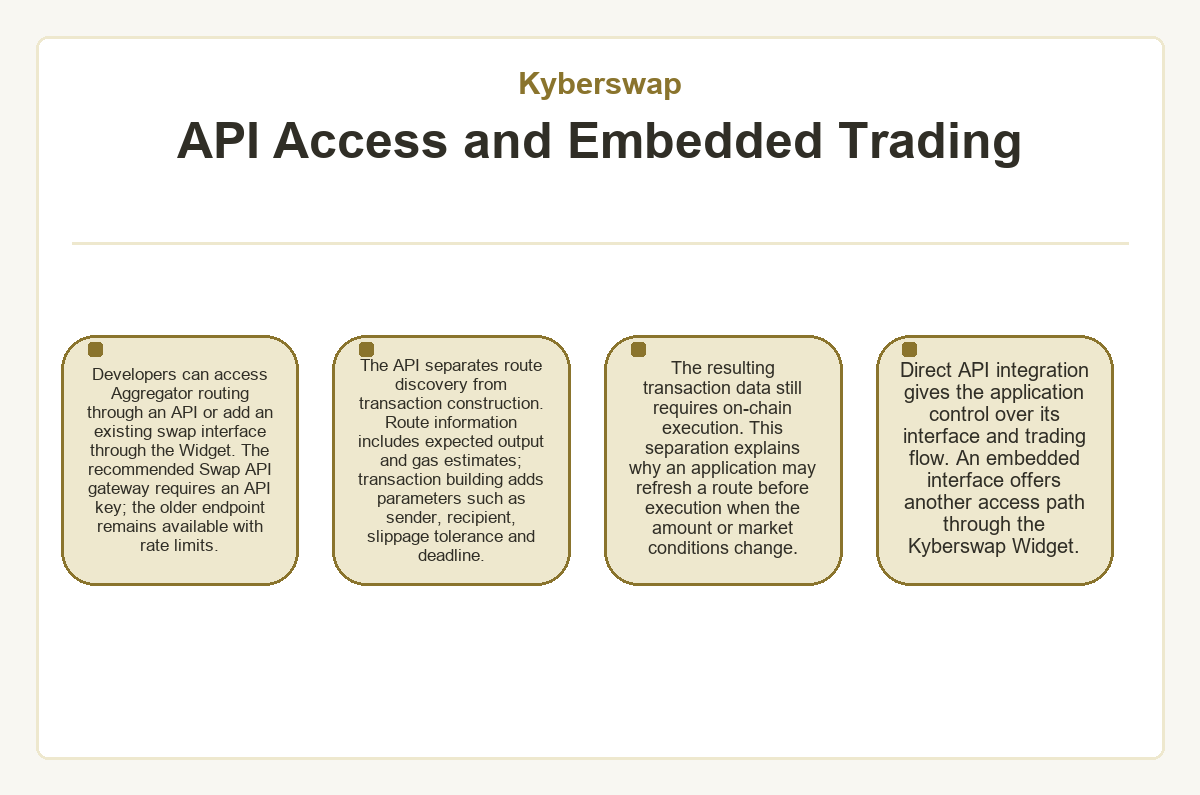
This separation explains why an application may refresh a route before execution when the amount or market conditions change. Direct API integration gives the application control over its interface and trading flow. An embedded interface offers another access path through the Kyberswap Widget.
Kyberswap: common questions
Can I Exclude Specific DEXs From an Aggregator Route?
The trading interface allows DEX filtering when it computes an Aggregator route. That selection changes which liquidity sources the router considers. Developers can also filter sources through the API using the relevant DEX identifiers; the available route then reflects those restrictions.
Is Cancelling a Limit Order Always gas-free?
Limit orders support Gasless Cancel and an on-chain Hard Cancel that requires gas. Gasless cancellation requires confirmation and should not be treated as immediate on-chain invalidation. A successful Hard Cancel transaction invalidates the order on-chain and incurs a network fee.
Why Is My Limit Order Only Partially Filled?
A partially filled order means that only part of its quantity has executed. Market liquidity, order size and available takers affect execution. The filled portion represents a completed trade, while the remainder can stay unfilled until another execution, expiry or cancellation.
Does an EVM Wallet Cover Every cross-chain Destination?
A connected EVM wallet can cover both ends of an EVM-to-EVM swap when it supports the selected networks. Other destinations have separate receiving-address requirements. For a Bitcoin or NEAR destination, enter a receiving address or connect a compatible destination wallet to supply it.
How Is a Concentrated Liquidity Position Recorded?
The underlying protocol determines how it represents a liquidity position, which may use an NFT-style record. KyberEarn provides a management interface for supported positions. My Positions shows position status, accrued fees and rewards, including whether concentrated liquidity is in range.
Has My Liquidity Deposit Completed If the Token Approval Succeeded?
A successful token approval does not establish that a liquidity deposit has completed. Approval authorizes the selected contract to spend the token. The main liquidity transaction must also complete successfully on-chain before it creates the position.
What Does the Low Volatility Pool Category Mean?
The Low Volatility category generally groups stablecoin or correlated-asset pools. That describes the relationship between the assets, rather than a protection against losses. Token price changes, smart contract exposure and changing incentive programs remain relevant when assessing a pool in that category.